Sustainability & Regeneration Viticulture
BETTER WINES
RESPONSIBLY
As a founding member of the Central Coast Vineyard Team, Steve McIntyre was one of the originators of SIP Certification program. Sustainable winegrowing is a “Big Picture” philosophy that considers the cumulative impact of every decision related to the three pillars of sustainability: Fiscal, Social and Environmental. To become SIP Certified, winegrowers must meet high standards in the following areas: habitat and ecology conservation, energy efficiency, pest management, water conservation, economic stability and human resources. To date, over 1,000 SIP Certification evaluations have been collected and the guiding principles of the program are permanently altering the way winegrowers think about farming.
Sustainable Regenerative farming is a self-correcting discipline that utilizes a self-assessment scoring system to evaluate one’s progress. It combines best management practices from other farming systems, like organic and biodynamic, to positively impact an organization’s triple bottom line: fiscal, environment and society. Sustainability is not about standards, it’s about metrics.
Steve McIntyre
A topic of frequent conversation at more than a few winemaker dinners these days is the difference between organic, biodynamic and sustainable farming systems. It is a confusing topic, a minefield of semantics and confounding nomenclature not easily defined.
MPI has had the opportunity to implement several different farming systems over the past 33 years, including organic, biodynamic, regenerative and sustainable systems. We have worked with renowned biodynamic and organic consultants; Alan York and Nicolas Joly from Coulee de Serrant in France. Currently, the majority of our acres is in the Central Coast are farmed sustainably, all of which is certified as such, under one of 4 separate systems: SIP (Sustainability in Practice), CSWA, Lodi Rules and Leading Harvest.
Regenerative sustainability considers the cumulative impact of one’s decisions. As an example, buying a Tesla makes one feel good about saving fossil fuel and producing little if any greenhouse gas or pollutants. However, if we look at the cumulative impact of the production and this vehicle’s ultimate disposition (in particular the manufacturing and disposal of the battery), we will find this vehicle has a larger carbon footprint than some hydrocarbon burning vehicles.
Everyone practices sustainability; none of us want to perish from this Earth before our time. Some are farther along the continuum in terms of consciousness than others. The same is true with farmers preserving a natural resource. Regenerative Sustainable is not a competition between growers, it is an internal self-correcting discipline. It is not something you ever actually attain, and everyone is at a different point along the continuum. The idea is to be able to measure improvement and that is where the metrics come in to play. Carbon footprint calculators, life cycle assessments, vine water status modeling, energy usage analysis and sustainability workbooks provide the basis for self-improvement and certification. The workbook products are particularly relevant, as these self-correcting documents change as new farming techniques or metrics are developed and adopted.
One of the great aspects of Regeneration Sustainable is that you don’t have to defend your standards as the pace of discovery accelerates and new peer review science becomes available, you can self-correct. No defense needed!
Regenerative Processes
Permanent, No-Till Cover Crop
Cover crops have been used for decades and their use in “permanent” crops, such as vineyard, has expanded significantly in recent years. The majority of vineyards in the state are now using them to some extent. Despite their widespread use, many growers do not utilize them in a permanent manner. Many elect to plant them on an ongoing, yearly basis and then incorporate them into the soil by means of cultivation, in order to increase organic matter and/or nitrogen levels. While this practice is certainly beneficial, it fails to fully take advantage of all the benefits of permanent cover crops. From a “carbon footprint” perspective, it arguably takes less carbon to implement a permanent cover crop system then one receives as a benefit for incorporating a cover crop each season.
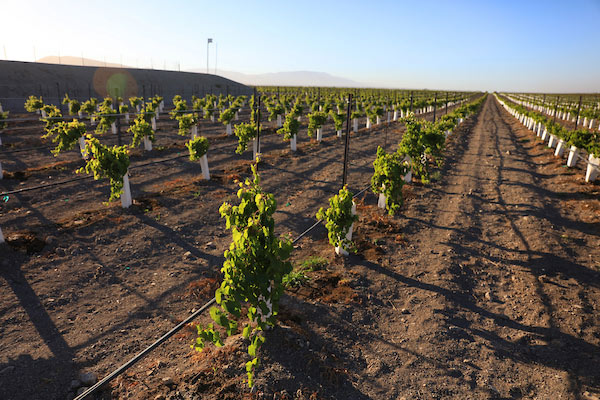
Monterey Pacific operates 19,000 acres of vineyards, all of which are farmed with permanent cover. Our cover crop system is unique in that the process and its numerous benefits were discovered by serendipity. It seems that the most elegant and robust solutions are often discovered in this manner!
Over the intervening years we have learned that cover crops (“roots are tillage”) reduce dust and erosion, increase ambient air temperature, reduce soil compaction by increasing soil tilth, increase organic matter, and provide an environment for beneficial insects. Additionally, recent research has shown permanent cover crops increase soil populations of mycorrhizae other beneficial bacteria and fungi, which are extremely important to overall plant health and wellbeing, as well as sequestering carbon.
Carbon Sequestration
certified in sustainability
Three years ago, we formed The Sitos Group to produce our own biochar from wood waste delivered to the Monterey County landfill in Marina, California. We are using a slow pyrolysis reactor to produce biochar in a self-sustaining exothermic reaction on a continuous basis (it’s not a batch system) producing biochar with an 80-82% carbon content, while meeting EPA and California Air Resources Board emission standards. An independent third-party lifecycle assessment indicated we are producing a ton of biochar for each three tons of wood waste, providing 2.6 tons of carbon dioxide removal credits (CDR) per ton of biochar produced and subsequently sequestered.
Biochar works best when mixed with compost. Biochar provides Mineral Associated Organic Matter (MAOM), a nearly permanent, stable carbon source for the microbiome (contained in the compost) providing a synergistic agronomic effect when sequestered in soil.
We have developed a patented injection device to apply the mixture in vineyards and orchards to a depth of 2 ½ to 3 feet on a pre-plant basis, or an existing vineyard or orchard.
We are currently building a three-reactor biochar production facility at Treehouse Almond in Bakersfield to utilize almond shell to produce biochar, as well as provide energy from the pyrolysis process back to the almond processing facility. It is set to open in early 2026 and will produce 8,000 tons of biochar per year, capable of sequestering 22,800 tons of CDR, which would otherwise end up in the atmosphere.
Over the course of the last 10 years, we have utilized biochar in three separate trials to evaluate the material for agronomic and carbon sequestration benefits. On an agronomic level, we continue to see statistically relevant benefits to grape production and vine capacity, as we increase the carbon content and organic matter in the soil.
Please see the Sitos Group website for more information on our progress.
- Ancient Farming Practice Draws Cash from Carbon Credits – Wall Street Journal Article, Feb 25, 2023
- SCVTG AUG 11, 2022 – Biochar in the Vineyard
Best Management Practices
sustainable & ORGANIC programs
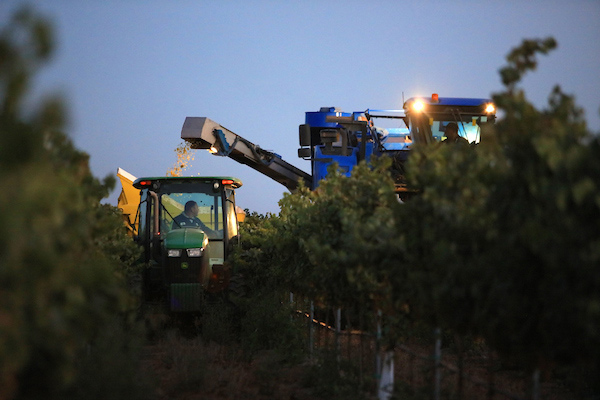
To meet the needs of our diverse client base, we have developed sustainable, organic and biodynamic farming programs. The knowledge we gain from each of these disciplines has a positive impact on all of our viticultural practices.
Winemaking
certified in sustainability
Presently, we make bulk wine and Private Label products for several entities, drawing on our experience and expertise founding and managing the Monterey Wine Company in King City, California. We currently utilize 4 separate facilities in Northern and Central California to process grapes. Please contact Steve McIntyre directly for further information.